 RecordbookHQ
Create Custom Sales Reports with Tags
Tags turn any slice of your pipeline into an instant report, by partner, program, industry or segment. How they work, and a tagging scheme that holds up.
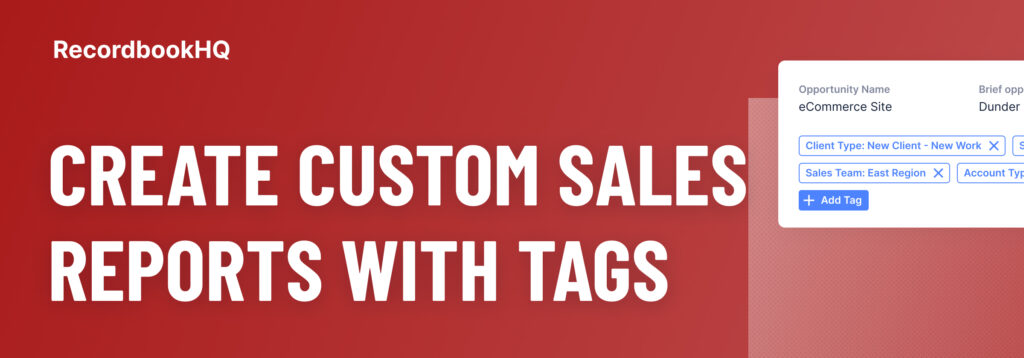
Every team eventually gets asked for a report nobody planned for. “How much pipeline do we have in healthcare?” “What’s forecast through the Azure marketplace?” “Which deals is our implementation partner on?” In most tools that means an export and an afternoon in a spreadsheet. In Recordbook it means a tag and a filter.
Tags are free-form labels you attach to sales opportunities. Filter by one, or several, and the opportunity list and the pipeline above it recalculate for just those deals. Any tag you apply consistently becomes a report you can pull in seconds.
Adding and removing tags
- Add a tag: on an opportunity, type the tag’s name and click +.
- Remove a tag: click an existing tag and a delete button appears. Click it to remove the tag from that opportunity.
There’s no admin screen to set up first. A tag exists as soon as someone uses it, which is what makes tags fast, and also why a naming convention matters (more on that below).
Filtering by tags
Click the filter icon to the right of the search bar and go to the Tags line. Type one or more tag names and click Apply. Every opportunity carrying those tags appears in the list, and the pipeline shows Closed, Forecast, Qualified and Unqualified revenue for just those deals.
Because the pipeline follows the filter, the filtered screen is the report. Set the From and To dates for the period you care about and you have that slice’s in-period numbers too.
Tags for co-selling teams
Partner teams get the most out of tags, because the questions they’re asked cut across the usual CRM fields:
- Partner tags such as partner-acme-consulting: everything you’re working with one partner, ready for a partner business review.
- Cloud and marketplace tags such as aws, azure or gcp-marketplace: pipeline by hyperscaler. If you co-sell with AWS, an AWS tag also puts every deal that belongs in ACE on one screen; the AWS ACE guide covers how Recordbook keeps ACE and your CRM in sync.
- Motion tags such as sourced or influenced: a quick view of how partner-touched deals came in, to sit alongside the attribution fields on each deal.
- Program tags for a funding program, a joint campaign or an event, so you can show what a program actually produced.
A tagging scheme that holds up
Free-form tags drift if nobody sets rules: “AWS,” “aws,” “Amazon” and “AWS Marketplace” end up as four tags for one thing, and every report misses some deals. A few rules prevent that.
- Pick a format and stick to it. Lowercase with hyphens (partner-acme-consulting) is easy to type and easy to read.
- Prefix by category. partner-, cloud-, program-, industry-. Prefixes keep related tags together and make the list easy to scan.
- Keep the list short and written down. One line in your team’s handbook per tag, with what it means and when to use it.
- Tag at creation. Tags added three months later are tags that got forgotten on half the deals.
- Retire tags on purpose. When a program ends, stop using its tag. Don’t rename it, or old reports stop matching.
Tags vs. other filters
Recordbook can also filter by account, contact, opportunity name and product or service metrics. Use those when the information already lives in a field. Use tags for everything that doesn’t have a field: partners, programs, campaigns, segments, internal initiatives. Combining both gives you views like “every healthcare deal with this partner closing this quarter” without a single formula. Advanced sales reports has more combinations.
Five reports teams build with tags
- Pipeline by partner, for each partner business review.
- Pipeline by cloud marketplace, for the alliance team.
- Pipeline by industry, for marketing and product.
- Pipeline from one event or campaign, to prove what it produced.
- Deals at risk, using a tag the team adds when a deal needs help.
Each one is a filter you can open any time, and each one is current the moment you open it.
Try it on your own pipeline
Recordbook is free to start. Every feature is on every plan, and adding your team or your partners costs nothing extra. Create your free workspace.
The Recordbook Fundamentals series
- What’s in a sales opportunity?
- Understanding your sales pipeline
- Sales management, all on one screen
- Sales tracking and reporting made easy
- Be in the know with sales notes
- Stay on track with sales action items
- Know your sales contacts
- Access sales intel in seconds
- Advanced sales reports
- Sales forecasting
- Sales goal tracking