 RecordbookHQ
Know Your Sales Contacts: Every Person on Every Deal
Keep track of every person on every deal, including buyers, champions, blockers, your team and your partner's, and see in one filter everything a contact is part of.
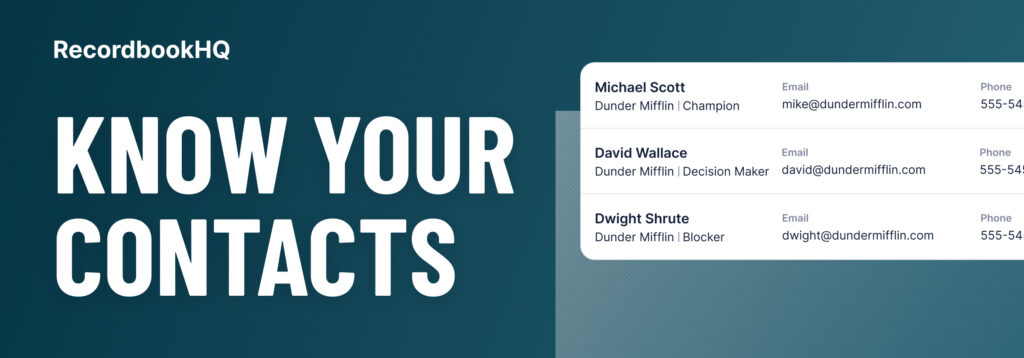
Deals are won by people, and lost when you forget who they are. The champion who went quiet, the procurement lead nobody met, the partner’s account manager who knew the budget was moving: missing any one of them can stall a deal for weeks. Recordbook keeps the people on every opportunity organized, so anyone picking up a deal knows who matters and how to reach them.
What a contact is
A contact is a person associated with a sales opportunity. Contacts can be external, at the customer or at a partner, or internal, on your own team. On the customer side they include decision-makers, influencers, blockers and other stakeholders. Keeping all of them on the opportunity means the history of who you’ve talked to survives handoffs, vacations and job changes.
Adding a contact
- Contact name
- Company: the organization they work for. This is how you tell a customer stakeholder from a partner’s rep.
- Title: their job title.
- Contact details: email, phone, address and LinkedIn.
Add contacts as you meet them, not at the end of the quarter. The point is to have the map while the deal is live.
Pinning the key contact
Every deal has one person who matters most right now: the champion, the economic buyer, or the partner rep driving it. Pin them. Open + Contact or edit an existing contact and click the pin icon at the bottom right of the section. It turns blue, and that contact appears on the main pipeline screen under Contacts, so the most important name is visible without opening the deal.
You can pin one contact per opportunity. That’s deliberate: if everyone is pinned, nobody is. Change the pin as the deal moves, from the champion early on to the signer near the end.
Seeing every deal a contact is on
Click the filters icon to the right of the search bar, type the person’s name in the contact name field, and click Apply. Every opportunity that lists them as a contact appears, and the pipeline at the top recalculates for just those deals.
That answers questions that are surprisingly hard elsewhere:
- “This buyer is moving to a new company. What were they involved in?”
- “How much pipeline is this partner rep working with us?”
- “I’m meeting this CFO tomorrow. Which deals has she touched?”
Mapping a co-sell deal
A co-sell deal has two buying teams to track: the customer’s, and the people on your partner’s side who are working it with you. A typical cloud co-sell deal might involve:
- the customer’s champion, economic buyer and procurement contact;
- your account executive and solutions engineer;
- the partner’s account manager or partner development manager;
- a cloud provider’s account team, if the deal runs through a marketplace.
Put all of them on the opportunity, with company and title filled in, and anyone on either team can see who’s who. Because Recordbook connects your CRM and your partner’s to one shared workspace, a contact your partner adds after their call shows up on the same deal for you. The Recordbook vs. Crossbeam comparison describes what happens when that coordination lives in direct messages instead: when a rep leaves, the context leaves with them.
Contact habits that pay off
- Fill in company and title every time. A list of names without companies is a puzzle, not a map.
- Add the blocker too. The person against the deal is the one you most need to remember.
- Re-pin as the deal moves. The pinned contact should be the person you’d call today.
- Log conversations as notes. The contact says who; sales notes say what they told you.
- Check contacts at every stage change. If a deal reaches late stage and the economic buyer isn’t on it, that’s a risk worth flagging.
Contacts and accounts work together
An account tells you which company a deal is with. Contacts tell you who inside it, and who on your side and your partner’s, is actually doing the work. Search the account for the company view; filter by contact for the people view. Between them, nobody on your team should ever have to ask “who are we talking to over there?”
Try it on your own pipeline
Recordbook is free to start. Every feature is on every plan, and adding your team or your partners costs nothing extra. Create your free workspace.
The Recordbook Fundamentals series
- What’s in a sales opportunity?
- Understanding your sales pipeline
- Sales management, all on one screen
- Sales tracking and reporting made easy
- Be in the know with sales notes
- Stay on track with sales action items
- Access sales intel in seconds
- Create custom sales reports with tags
- Advanced sales reports
- Sales forecasting
- Sales goal tracking