 RecordbookHQ
Access Sales Intel in Seconds: Accounts in Recordbook
Link every deal to an account and one search gives you the full picture: every opportunity, every contact, and that account's own pipeline.
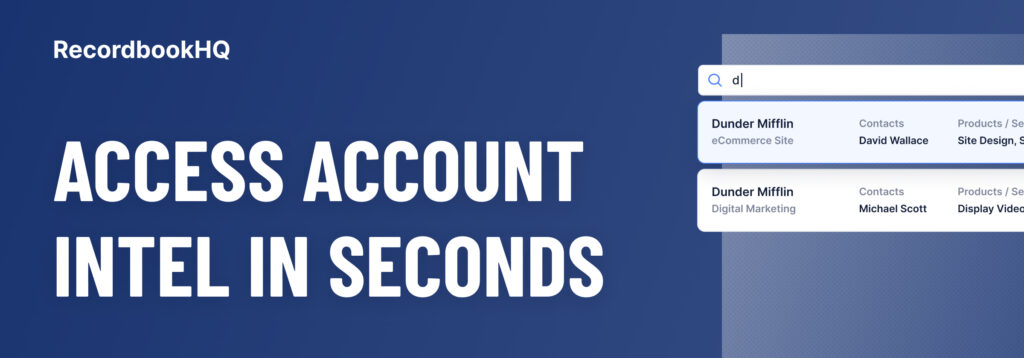
Five minutes before a customer call, you need three things: what you’re selling them, where each deal stands, and what happened last time. If that information is spread across a CRM, an inbox and a partner’s spreadsheet, you walk in half-prepared. Recordbook keeps it in one place, organized around the account, so the whole picture is one search away.
What an account is
An account is the company or organization you’re selling to. Every sales opportunity should be linked to one. That link is what lets Recordbook pull together everything you have going with a customer, across every deal, rep and partner involved.
Adding an account
- Account name: the company’s name. Use the legal or commonly used name consistently, because search depends on it.
- Type: a category of your choosing, such as industry, size or region.
- Subtype: a second category, if you need one.
- Contact details: website, phone, address and LinkedIn.
Type and subtype are yours to define. A software company might use industry and company size. A services partner might use the cloud platform and the customer’s maturity. Pick a scheme early and keep it consistent.
Seeing everything for one account
Type the account name into the search bar and click search. Every opportunity linked to that account appears in the list, with its products and services, contacts, notes and action items one click away.
The pipeline at the top of the screen recalculates too. It shows only that account’s Closed, Forecast, Qualified and Unqualified revenue, so the account’s value and outlook are right in front of you without building a report.
A two-minute account brief
Before any important call, this is the routine:
- Search the account. Read the pipeline totals: how much is won, how much is in play, what’s forecast.
- Sort by notes (newest). Read the latest notes on each opportunity to see what’s changed since the last conversation.
- Sort by action items due. Check what you promised and what’s overdue before the customer brings it up.
- Check the pinned contacts. Confirm who the key person is on each deal, and on which side.
Two minutes, and you’re the best-prepared person on the call.
Account intel when you co-sell
Shared accounts are where partner teams lose the most context. Your partner knows things your AE doesn’t: what the cloud account team committed, which stakeholder is skeptical, what the customer’s procurement window looks like. When that lives in a partner’s email or a separate CRM, your AE walks into the meeting blind.
Recordbook connects your CRM and your partner’s to one shared workspace, so notes, contacts and next steps on a shared account sit on the same records for both teams. When a partner adds a note after their call with the customer, it’s there the next time you search the account. No forwarded threads, no “let me check with my partner and get back to you.”
It also makes account planning concrete. Search the account, filter by the partner’s tag, and you see exactly what the two companies are working on together, with the revenue attached. That’s a better starting point for a joint account plan than a slide of logos. The co-selling guide covers why shared visibility at the account level is the fix most co-sell programs are missing.
Keeping account data clean
- One account per company. Duplicate accounts (“Acme,” “Acme Inc.,” “ACME Corp”) split the history and make searches miss deals. Search before you create.
- Link every opportunity. An opportunity without an account won’t show up when someone searches that customer.
- Use type and subtype the same way every time. They’re only useful for grouping if everyone applies them the same way.
- Keep contacts on the deals. Account details tell you who the company is; contacts tell you who you’re actually talking to.
Beyond one account
Search answers “what do we have with this customer?” For questions across many accounts, such as every deal in an industry, every deal with a partner or every deal closing this quarter, use filters and tags. The advanced sales reports guide shows how to combine them.
Try it on your own pipeline
Recordbook is free to start. Every feature is on every plan, and adding your team or your partners costs nothing extra. Create your free workspace.
The Recordbook Fundamentals series
- What’s in a sales opportunity?
- Understanding your sales pipeline
- Sales management, all on one screen
- Sales tracking and reporting made easy
- Be in the know with sales notes
- Stay on track with sales action items
- Know your sales contacts
- Create custom sales reports with tags
- Advanced sales reports
- Sales forecasting
- Sales goal tracking